


Are you an Auctioneer or the Auctionpreneur?
Hint: you can be both!
By Jude Campbell, CEO
Language is important. It frames how we see the world.
For the last 50 years, the auction industry has been defined by a single word: Auctioneer.
When you hear that word, you likely picture a specific archetype: Someone on a podium, calling bids at a rapid-fire pace. Someone who follows deep-rooted traditions. Someone who likely pays high fees to legacy software providers because “that’s how it’s always been done.”
But lately, looking at the data inside Selling Lane, we realized that the word “Auctioneer” didn’t quite fit the new users flooding our platform.
These users weren’t just calling bids; they were building digital brands.
They weren’t weighed down by heavy infrastructure or massive physical lots; they were agile.
They didn’t see technology as a necessary evil or a “tax”; they saw it as a weapon to scale volume.
The industry was missing a word for them. So, we decided to invent one.
Meet the Auctionpreneur
We didn’t build Selling Lane for the “Old Guard.” We built it for this new persona.
auc·tion·pre·neur
/awk-shun-pre-nur/
(noun)
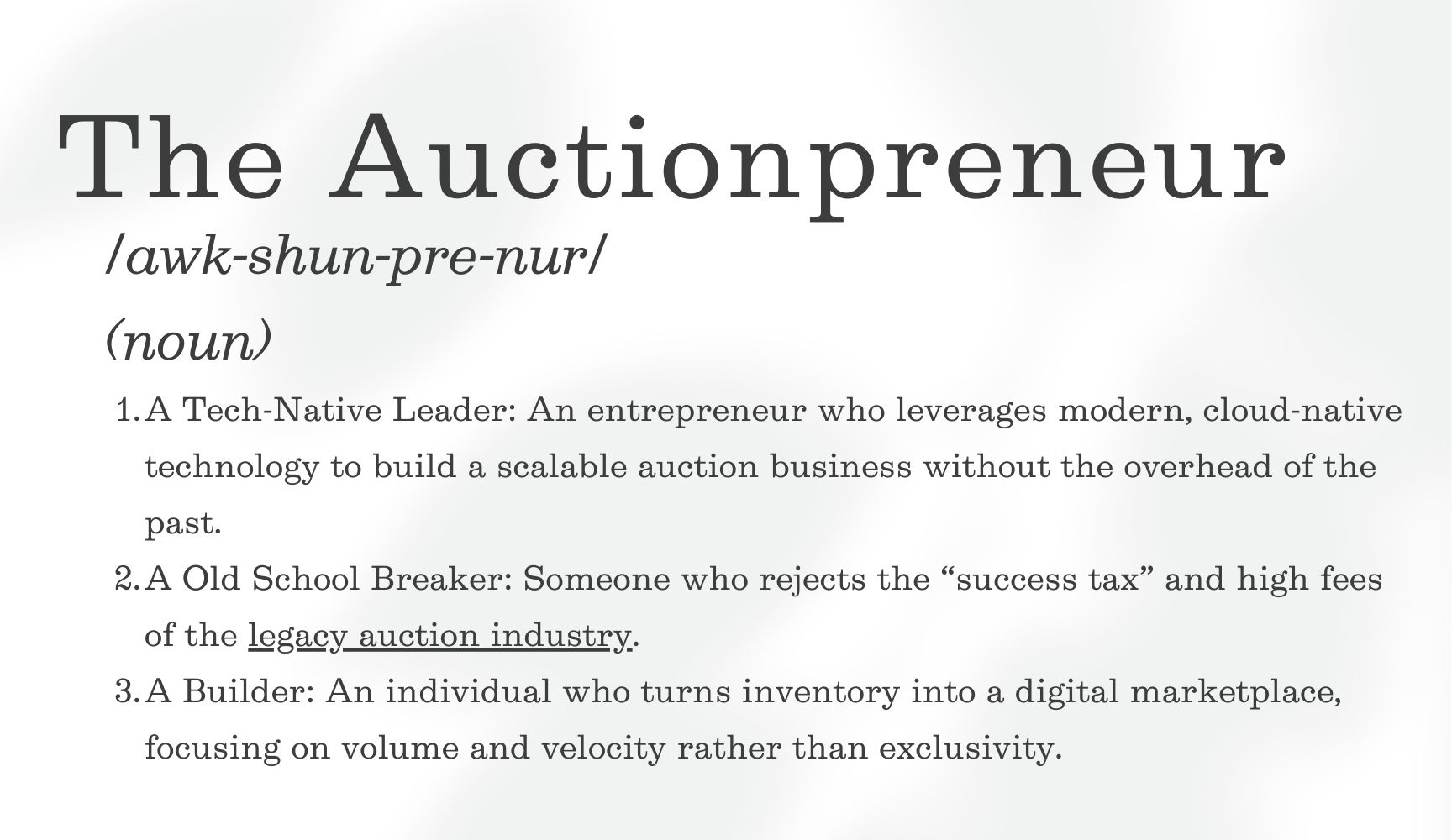
- A Tech-Native Leader: An entrepreneur who leverages modern, cloud-native technology to build a scalable auction business without the overhead of the past.
- A Gatekeeper Breaker: Someone who rejects the “success tax” and high fees of the legacy auction industry.
- A Builder: An individual who turns inventory into a digital marketplace, focusing on volume and velocity rather than exclusivity.
The Shift from “Gatekeeper” to “Launchpad”
In the old model, software companies acted as gatekeepers. If you wanted to play the game, you had to pay the toll. This kept the number of auction houses small and the fees high.
The Auctionpreneur rejects that model. They look at companies like Shopify or Square and ask, “Why can’t running an auction be that simple?”
We agree.
The “Shopify era” of auctions is finally here. You no longer need a massive physical footprint, a server room, or a restrictive $50,000 software contract to launch your business.
You just need the inventory, the hustle, and the right toolset.
Which One Are You?
The distinction isn’t just about age or experience; it’s about mindset.
An Auctioneer asks: “How much will this software cost me per car?”
An Auctionpreneur asks: “How fast can I scale this operation to 1,000 cars?”
An Auctioneer worries about protecting their territory.
An Auctionpreneur worries about expanding their reach.
We are placing our bet on the latter. We believe that if we remove the barriers to entry, thousands of new businesses will launch this year. We aren’t here to tax the existing giants; we are here to arm the rebels.
So, if you are ready to build a business that values volume over fees and innovation over tradition—welcome home.
Your gavel is waiting.
10 Reasons to Become an Auctionpreneur Today
 We coined the term Auctionpreneur because the old word—”Auctioneer”—felt heavy. It felt like it belonged to a bygone era of dusty lots, slow processes, and expensive barriers to entry.
An Auctionpreneur is different. They are agile. They are digital-first. And they are building the future of the resale economy.
If you’ve been thinking about starting your own auction business—whether for cars, estate sales, or heavy equipment—here are 10 reasons why there has never been a better time to pick up the gavel.
1. The Gatekeepers Are Gone
Ten years ago, you needed a server room, an IT team, and a $50,000 software license to run a professional auction. Today, you can launch a global auction platform from your laptop for less than the cost of a utility bill. The barrier to entry has crumbled.
2. You Don’t Need Land to Launch
The “Old Guard” believes you need 50 acres of asphalt to be an auctioneer. The Auctionpreneur knows better. With digital-first platforms like Selling Lane, you can run timed, online auctions where the inventory sits at the seller’s location until it’s sold. You can build an empire without the overhead of real estate.
3. It’s Recession-Resilient
When the economy is booming, people buy new. When the economy tightens, people buy used. Auctions are one of the few business models that thrive in both up and down markets. As an Auctionpreneur, you are providing liquidity when people need it most.
4. Cash Flow Velocity
Traditional retail is slow; you buy an item and hope it sells in 60 days. Auctions are fast. You set a date, the timer ends, and the money moves. The Auctionpreneur prioritizes velocity of capital over holding out for retail margins.
5. You Become the “House”
When you sell on someone else’s platform (like eBay or a giant wholesale auction), you are a tenant paying rent. When you launch your own auction site, you are the landlord. You own the data, you own the customer relationship, and you keep the fees.
6. The “Treasure Hunt” Psychology
Human beings are wired to love the thrill of the win. That dopamine hit of winning a bid creates loyal, returning customers in a way that fixed-price retail never can. You aren’t just selling a product; you are selling an event.
7. Scalability via Software
In the past, doing more volume meant hiring more clerks. Today, modern automation handles the heavy lifting. Whether you sell 10 items or 1,000 items this week, the software does the invoicing, the tracking, and the reporting. You can scale your revenue without scaling your headaches.
8. Niche Dominance
The giant auction houses are too big to care about the small stuff. This leaves massive opportunity for you to dominate a niche. Be the king of “Classic Corvettes in Ohio” or “Farm Equipment in Nebraska.” The riches are in the niches, and technology lets you reach those specific buyers instantly.
9. Total Transparency (Trust = Profit)
The old auction world was smoky and secretive. The Auctionpreneur wins by being radically transparent. With clear condition reports and transparent bidding histories, you build trust faster. And in this industry, trust is the only currency that matters.
10. Legacy
You aren’t just flipping cars or selling grandmas’ antiques. You are building a brand. By establishing your own marketplace, you are creating a sellable asset—a business that runs on processes, not just your personality.
The tools are ready. The market is waiting.
Are you ready to claim your title?