

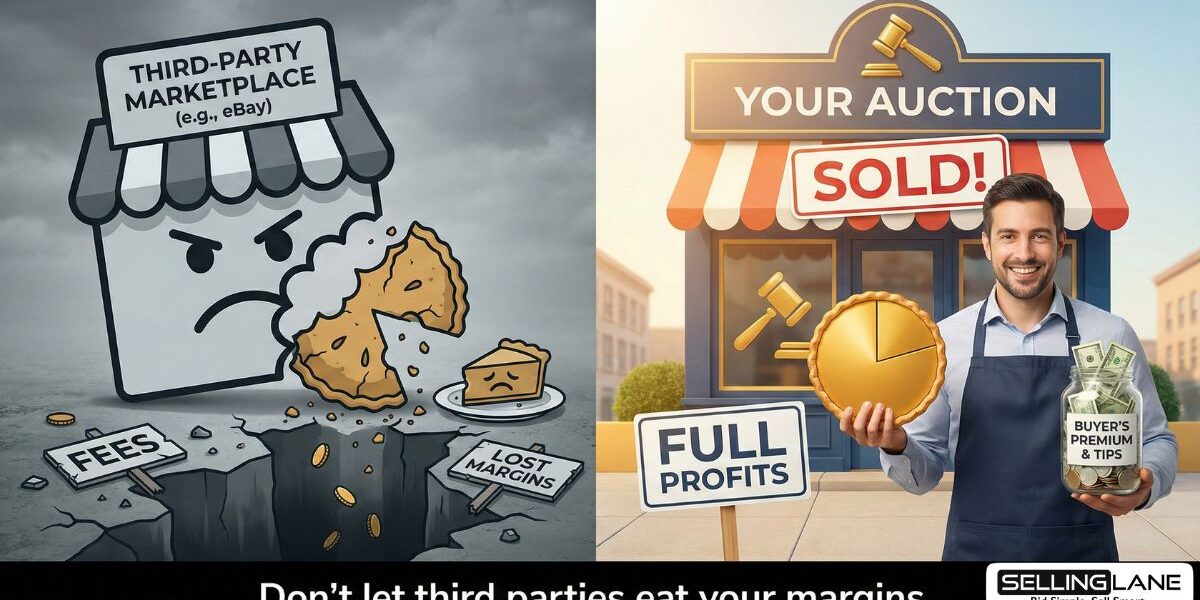
Turn your liquidation problem into a profit center, keep the fees, and build your own brand.
If you are a business owner selling surplus inventory, returns, or assets on third-party marketplaces like eBay, you are likely leaving massive amounts of money on the table. You are doing the hard work—sourcing, stocking, and shipping—while a third-party platform quietly siphons off your margins.
The hard truth is that most businesses treat liquidation as a disposal problem. They should be treating it as a franchise opportunity.
Here is why you should run your own auction first, and why the “easy way” of using paid services is actually the expensive way.
1. The “Franchise Within a Franchise” Model
 When you list an item on a third-party site, you are just a seller. When you run your own auction, you are the house.
Think of an in-house auction division as a “franchise within your franchise.” It is a separate profit center that does not just recover costs—it generates new revenue. Instead of selling your items for pennies on the dollar to a liquidator or paying steep fees to a marketplace, you control the entire ecosystem.
You control the timing, the marketing, and most importantly, the revenue flow. By owning the auction software, you turn a back-office task into a front-facing business unit that adds valuation to your company.
2. Stop Paying the “Success Tax” (The Math is Simple)
Your Own Auction VS eBay
The most compelling reason to switch is simple arithmetic. Third-party platforms charge you for the privilege of selling your own items. We call this the Success Tax.
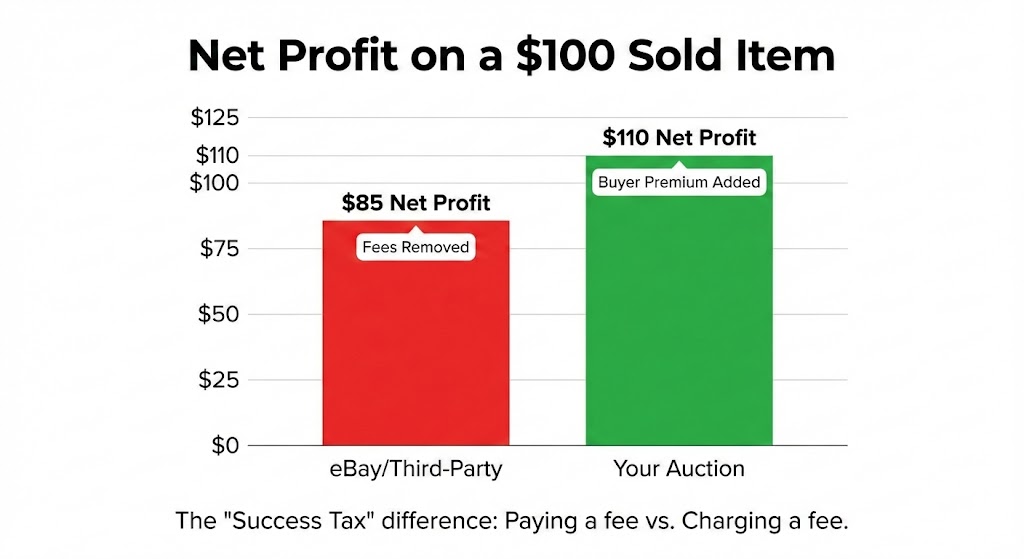
Let’s look at the math on a $100 item:
The eBay/Third-Party Way: You sell an item for $100. The platform takes a seller fee (often 10-15%), plus listing fees and payment processing. You might net $85.
The Owned Auction Way: You sell that same item for $100. But here is the secret: In the auction world, it is standard to charge a Buyer’s Premium (often 10% or more). That means the buyer pays $110. You keep the $100 sale price PLUS the $10 fee.
The Profit Difference:
Third-Party: You Net $85
Owned Auction: You Net $110
That is a huge swing in profitability on the exact same item. Why pay a fee when you can charge one?
3. Build Your Brand, Not Theirs
When you send a customer to eBay, you are building eBay’s traffic, eBay’s SEO, and eBay’s customer list. If that customer buys your item, they don’t remember you; they remember they “bought it on eBay.”
When you decide to run your own auction:
You own the traffic: Every click improves your website’s SEO.
You own the customer: You capture the email address and phone number of every bidder, allowing you to market to them again and again for free.
You build loyalty: Customers return to your site to see what is new, effectively turning one-time buyers into lifetime clients.
4. Control Your Destiny
Relying on a third-party platform is like building a house on rented land. They can change their algorithm, raise their fees, or suspend your account on a whim.
Owning your auction software gives you sovereignty. You decide the rules, the bid increments, and the schedule. You are no longer at the mercy of a “silent partner” who takes a cut of your revenue without doing any of the heavy lifting.
The Bottom Line
Stop feeding the beast. If you have inventory to sell, you have the power to create a marketplace. Run your own auction, keep the fees, and turn your liquidation struggles into a profitable new division of your business.